


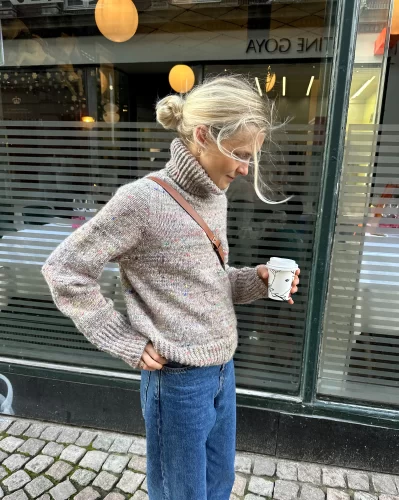
Terrazzo Sweater
45,00 DKK
The Terrazzo Sweater is worked from the top down, first back and forth on the circular needle to form the neckline and then in the round on the circular needle. The yoke is constructed by first working shoulder increases on the RS and WS. Next, sleeve increases are worked, and finally a piece with raglan increases is worked. Finally, the large neck turtleneck is worked from picked up sts and worked in rib with twisted sts. The sleeves are worked in the round on double-pointed needles or using the Magic Loop technique. Knit a test swatch to find the needle size that gives you the right gauge.
Out of stock
Size guide
The Terrazzo Sweater should have a positive ease of approximately 14 cm in relation to your chest measurement. Sizes XS (S) M (L) XL (2XL) 3XL (4XL) 5XL correspond to a chest measurement of 80-85 (85-90) 90-95 (95-100) 100-110 (110-120) 120-130 (130-140) 140-150 cm. The measurements of the finished sweater are given on the front of the pattern Note: These measurements only apply if the gauge is followed. Measure yourself before you start knitting to assess which size will fit you best. For example, if you measure 90 cm around your chest (or the widest part of your body), you should knit a size S. A size S sweater. S sweater has an overall width of 104 cm and in this example would give you a positive ease of 14 cm.
Sizes: XS (S) M (L) XL (2XL) 3XL (4XL) 5XL
Sweater width: 98 (104) 109 (113) 124 (134) 141 (151) 155 cm
Length: 57 (58) 60 (62) 63 (65) 66 (68) 70 cm (measured mid back without turtleneck)
Gauge: 17 stitches x 25 rows in stockinette stitch on a 5 mm needle = 10 x 10 cm after washing and blocking
23-24 stitches x 24 rows in rib (k1 tbl, p1 tbl) on a 4 mm needle = 10 x 10 cm after washing and blocking (gauge for the turtleneck)
Recommended needles: 5 mm circular needle (40, 60 and 80 and/or 100 cm), 4.5 mm circular needle (80 cm), 4 mm circular needle (40 cm), 4.5 mm and 5 mm double pointed needles
Materials: Proposal 1: 500 (500) 600 (600) 600 (600) 600 (600) 700 (700) 700-800 g Noro Madara (100 g = 200 m)
Suggestion 2: 600 (600) 700 (700) 700 (700) 700 (800) 800 (900) 900-1000 g Aran Tweed from Isager Yarn (100 g = 160 m)
Suggestion 3: 400 (400) 400 (400) 400 (400) 400 (500) 500 (500) 500 g Noro Silk Garden Sock Solo (100 g = 300 m) together with 125 (125) 125 (125) 125 (125) 125 (150) 150 (150-175) 175 g Silk Mohair from Isager Yarn (25 g = 212 m) or Thin Silk Mohair from Sandnes Garn (25 g = 212 m)
Difficulty: ★ ★ ★ ★ ★ ★ (4 out of 5)
| Weight | 0,05 kg |
|---|


Related products

Agnete Cardigan
The Agnete Cardigan is worked from the top down in patent knit. First knit a double knit piece to sit at the neck and connect with the front edges. Next, pick up stitches in this piece and work the back piece from there. Then knit the right front and left front. These three pieces are joined to form the body, which is worked back and forth in patent with front edges in double knit. Buttonholes are worked along the double knit front edges. Stitches are picked up in the armhole and from these stitches the sleeves are worked.
Make a swatch before you start to find the needle size that gives you the right gauge. Please note that the gauge in height (i.e. number of rows per 10 cm) can vary depending on the yarn you are knitting with. The most important thing is that the width gauge (i.e. number of sts per 10 cm) is correct. There is a video of the patent knitting and double knitting techniques at www.petiteknit.com.


